

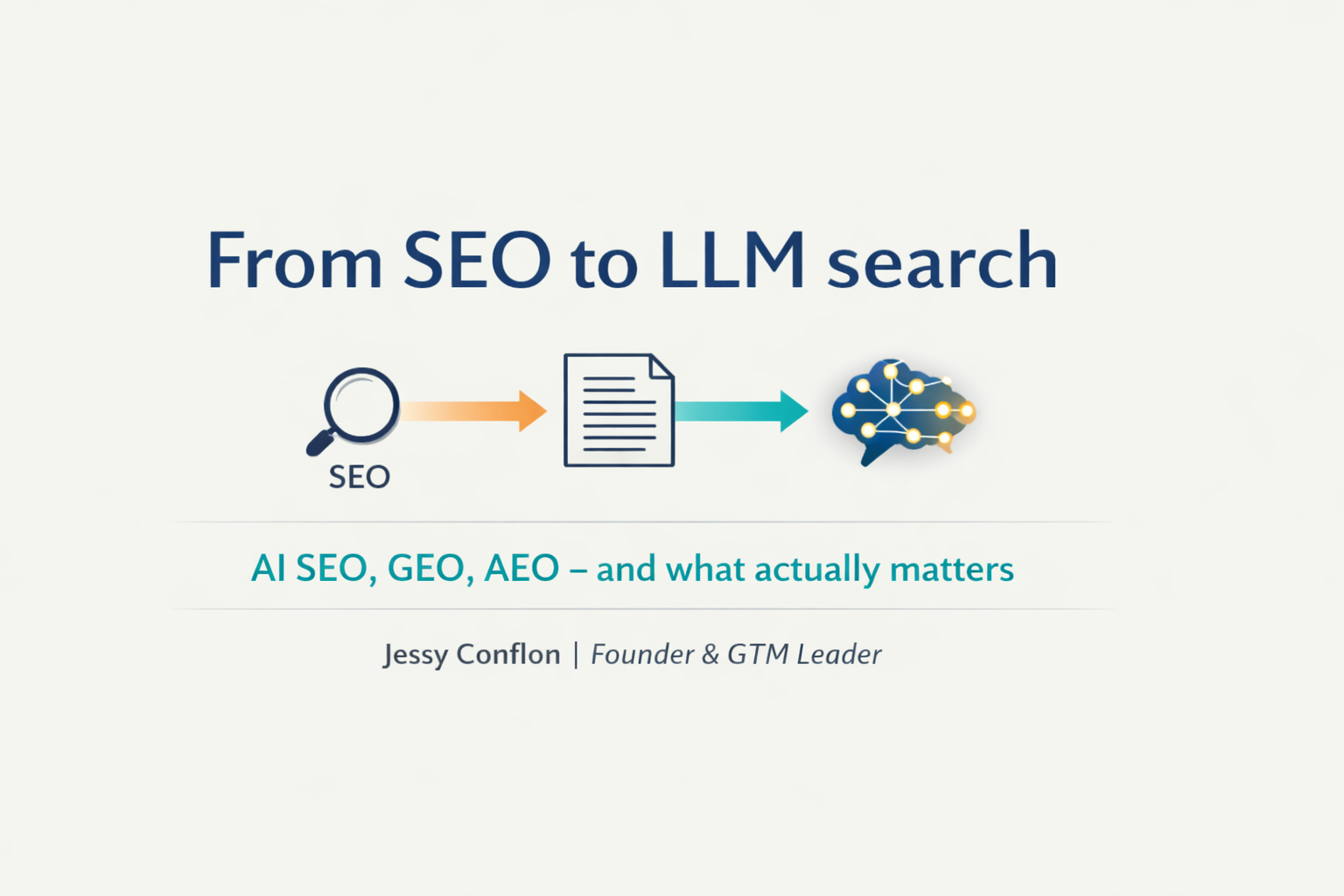
For years, as marketers, we thought we understood the role of SEO.
We researched keywords, optimised pages, built links and waited for Google to reward us. SEO was never simple, but it was familiar.
Over the last year or so, a lot of new terms have started popping up: AI SEO, LLM search, GEO, AEO, AI search optimisation.
I’ve spoken to a lot of marketers who say it feels like SEO all over again – but this time, even the language is confusing.
The problem isn’t that marketers don’t understand SEO. It’s that search has changed faster than the words we use to describe it.
What actually changed: from search engines to language models
Traditional search engines work by crawling and indexing web pages, then ranking them based on relevance and authority.
Large language models work differently.
Tools like ChatGPT, Perplexity and Google’s AI-led search results don’t just point people to pages. They read content, interpret it, summarise it and present answers directly.
Instead of typing short keyword phrases, people now ask full questions like:
- How do I optimise AI-generated content for SEO?
- Is AI-written content accurate?
- What’s the difference between SEO and AI search?
This shift matters because content is no longer just being ranked. It’s being understood.
For us as marketers, that changes how we write, structure and check content.
What do we actually mean by LLM search?
When people talk about LLM search, they’re not talking about a single tool or platform.
It’s just a way of describing how people are now finding information using systems built on large language models.
These systems tend to:
- read and interpret content rather than scan for keywords
- prioritise clear explanations
- pull answers directly from content
- rely heavily on factual accuracy
In practice, that includes:
- AI chat tools like ChatGPT or Claude
- AI tools designed specifically for search, like Perplexity
- Google’s AI-led search results
The key difference is this: content is no longer just indexed. It’s interpreted, summarised and sometimes cited.
Why are there so many new terms?
Every major shift in marketing creates new language.
SEO did it. Social media did it. Content marketing did it.
AI-driven search sits at the intersection of a few different worlds:
- SEO specialists
- content marketers
- AI engineers
- product teams
- founders and operators
Each group tried to describe the same shift from their own perspective. That’s why we now have so many overlapping terms, often talking about very similar things.
The main terms people are using (and what they usually mean)
AI SEO
AI SEO is probably the most common term you’ll hear among marketers.
It frames optimisation for AI-driven search as an evolution of SEO, rather than something completely new.
In practice, AI SEO usually refers to:
- structuring content clearly
- answering real questions directly
- improving accuracy and clarity
- making content easier for AI systems to understand and summarise
Because it builds on familiar SEO concepts, it tends to resonate with non-technical teams.
GEO (Generative Engine Optimisation)
GEO focuses on how content is used by generative AI systems, rather than how it ranks in traditional search results.
In simple terms, it’s about creating content that AI systems can reliably read, interpret and reuse when generating answers.
As Neil Patel puts it, “generative engine optimisation focuses on helping AI systems understand and use your content when generating answers, not just ranking it in search results.” https://neilpatel.com/blog/geo-vs-aeo/
One practical issue is that many marketers hear GEO and assume it means geographic SEO, which doesn’t help.
In practice, GEO and AI SEO often overlap significantly.
AEO (Answer Engine Optimisation)
AEO originally came from voice search and featured snippets.
It focuses on making content easy to surface as clear, direct answers to specific questions.
It’s still relevant, but it’s narrower in scope and usually sits inside broader AI SEO or GEO efforts, rather than standing on its own.
LLM optimisation / AI search optimisation
These terms are more commonly used in technical contexts.
They describe optimisation specifically for how large language models interpret and generate responses.
They’re accurate, but most marketers don’t tend to use them in day-to-day conversations.
Which terms are marketers actually using?
In practice, it depends a lot on who you’re talking to.
Among generalist marketers and business owners, AI SEO is by far the most common term I hear. AI search is also widely understood, but it’s often used quite loosely.
When I speak to SEO specialists, GEO and AEO come up more often. The language is usually more precise, but also less accessible.
And across platforms like LinkedIn, X and Reddit, conversations framed around AI SEO tend to get more engagement than more technical acronyms.
The takeaway is pretty simple: marketers gravitate toward language that feels familiar and actionable.
What matters more than the terminology
The names will keep changing, but the underlying principles are surprisingly stable.
Across SEO, AI SEO, GEO and LLM search, the content that performs well tends to have the same things in common:
- clear structure
- focused topics
- direct answers to real questions
- accurate, verifiable information
- language that’s easy to understand
The biggest shift isn’t technical. It’s editorial.
Content needs to be written not just for ranking, but for understanding.
How to think about content strategy going forward
For most marketers and business owners, the smartest approach isn’t to chase acronyms.
Instead, it helps to:
- treat AI-driven search as an extension of SEO
- focus on improving content quality, rather than trying to game systems
- accept hybrid workflows where humans write, AI assists and models interpret
AI has changed how content is consumed. It hasn’t changed the value of clarity, usefulness and trust.