

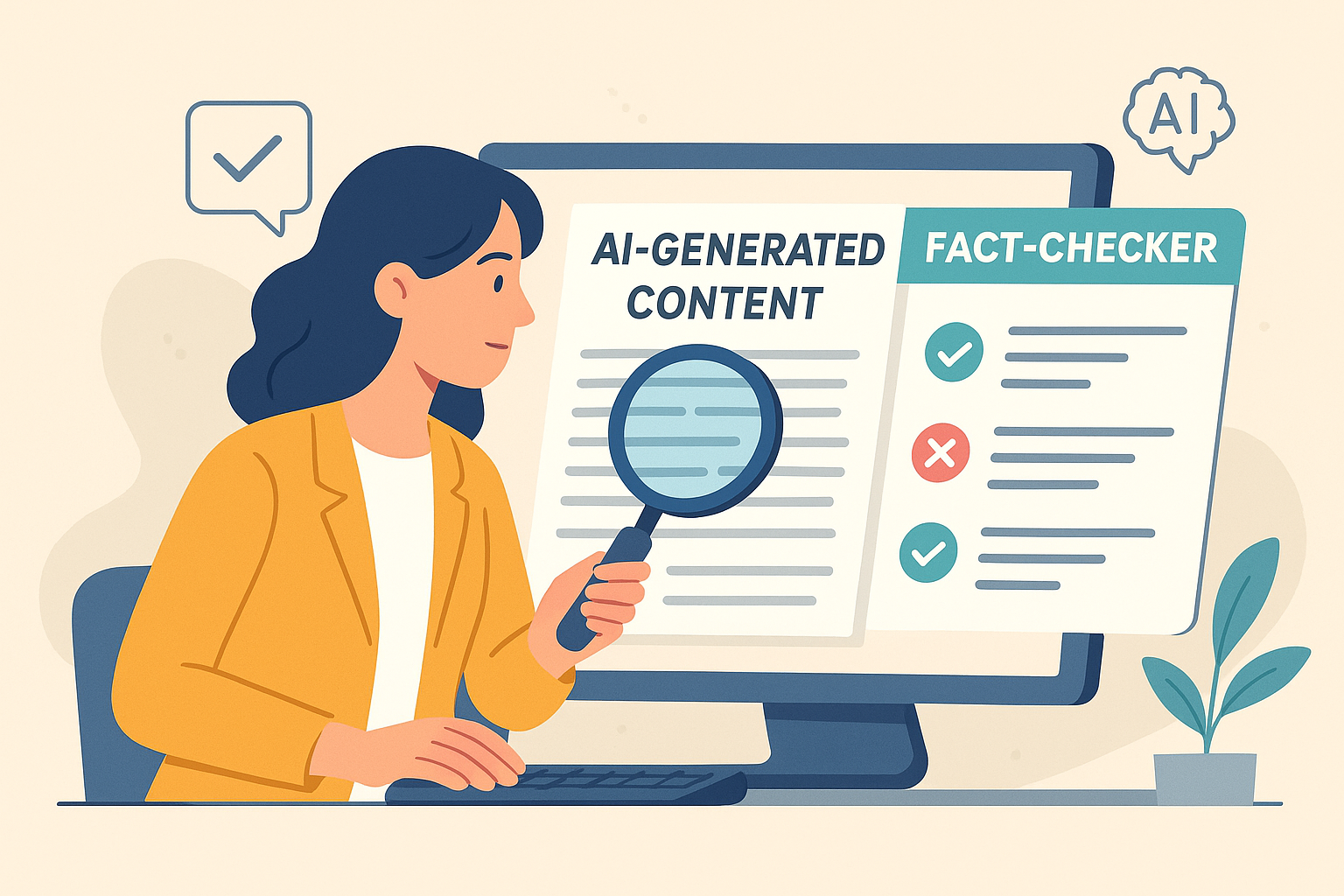
Ultimate Guide to AI Content Fact-Checking in 2026
Introduction
Businesses are creating more AI content than ever, but ensuring that content is accurate and reliable remains a major challenge. If you review blog drafts, check claims in reports, or validate social posts made with tools like ChatGPT or Claude AI, you need to know how to fact check AI generated content.
Fact-checking AI-generated content is now a top priority for marketers who use automation but still require accuracy and trust. Recent research highlights this change. A 2025 blind test in Advances in Business and Industrial Marketing Research found that 68% of marketers rejected AI-generated reports, even when those reports were objectively better. The main problem is not just how the models perform, but the growing gap between what AI creates and what marketers feel comfortable publishing.
This guide explains what AI content fact checking is, why AI hallucinations happen, how to pick the right fact checker tool, and what a good verification workflow looks like. You’ll also see how toos like ContentLift by YAi help teams check AI generated content with confidence, combining automation with human review. If you’re choosing between content optimisation tools and dedicated content verification solutions, this resource offers clear comparisons and practical advice.
TL;DR / Quick Answer Box
AI content fact checking means checking claims, data, accuracy, and sources in AI generated content to reduce mistakes and limit AI hallucinations. In 2026, the best method combines automated checks with human review to ensure high AI accuracy across marketing workflows.
Marketers can use dedicated fact checker tools or broader content validation platforms to make this process easier, work more efficiently and keep audience trust.
Section 1: What Is AI Content Fact-Checking?
AI content fact-checking uses automated or hybrid tools to fact check claims, data points, and references in AI-generated content before publishing. The main goal is to make sure the information produced by AI models is accurate, up-to-date, and matches trusted sources.
A fact checker tool in the AI content context is a system that analyses text for potential inaccuracies. It flags questionable statements, cross-references external datasets, and identifies areas where human review may be needed. This matters because large language models still struggle with AI accuracy, especially when handling niche topics or outdated information. For example, research from OpenAI andStanford HAI shows that AI can produce hallucinated or unsupported claims if not carefully verified.
When marketers discuss fact checking for AI content in 2026, they’re referring to a workflow that blends smart automation with strategic human validation. Think of it as a critical quality layer that protects your brand and increases trust in your outputs. It reduces errors, strengthens messaging, and helps teams publish high-quality content confidently at scale.
For teams looking to try a reliable content validation platform, ContentLift offers a free trial where marketers can check AI generated content, detect inaccuracies, and improve workflow efficiency.
Section 2: How AI Content Fact-Checking Works
AI content fact-checking uses both automated detection and human judgment. Most modern systems follow a predictable workflow that ensures AI accuracy and reduces hallucinations in AI:
-
Claim Extraction
The fact checker tool identifies statements that need verification, such as statistics, dates, or strong assertions. This separates verifiable facts from opinions. -
Source Comparison
The system checks extracted claims against trusted datasets or sources. An AI content checker may use academic references, government databases, industry reports, or internal knowledge bases. For example, Google Scholar or PubMed can be leveraged to verify critical claims. -
Hallucination Detection
AI hallucinations happen when a model creates information that sounds plausible but isn’t based on facts. Spotting these errors is important for marketers because they can show up in blogs, ads, scripts, or social posts without warning. -
Content Validation
The system produces a content validation report listing inaccuracies, unsupported claims, and suggestions for improvement. Some platforms, like ContentLift, offer rewrite recommendations to help teams quickly correct errors. -
Human Oversight
A human reviewer approves or edits the final content, adding context and nuanced judgment that AI alone cannot provide. This human-in-the-loop approach outperforms fully automated systems and guarantees high-quality, reliable outputs.
This step-by-step process shows why there are different types of AI content fact checking tools, from simple browser extensions to advanced platforms for large teams.

Section 3: Benefits and Use Cases for Marketers
Fact-checking AI content does more than reduce errors. It also strengthens your content strategy throughout the marketing workflow:
- Better Brand Trust
Publishing inaccurate information can hurt your credibility. Fact-checking AI content makes your outputs more accurate and helps your audience trust your message. Tools like ContentLift let teams check AI generated content using both automated checks and human review.
- Higher Performance Content
Verified content ranks higher in search results. Search engines value reliable information, and teams see better results when they check AI generated content before publishing. Clean, validated data also helps with structured snippets, featured answers, and getting cited.
- Risk Reduction
Incorrect claims can cause compliance problems, especially in regulated industries. Using fact checking sites or automated content validation tools lowers publishing risks and helps ensure accuracy and legal safety.
- Stronger Creative Output
When teams automate verification steps, they can spend more time on creative work instead of manual checking. A reliable content validation workflow helps marketers create more quality content efficiently and with fewer revisions.
Key Use Cases
- SEO teams validating blog content before publishing
- Brand teams reviewing high-visibility campaigns
- Agencies managing multiple client accounts
- Social teams needing rapid verification before posting
- Product marketers preparing feature announcements
When asked if AI content verification is worth the investment, the answer is clearly yes. It reduces risk, improves AI accuracy, and speeds up production for any team using AI at scale. Gartner predicts that by 2026, 60% of CMOs will adopt content authenticity technology, enhanced monitoring and brand-endorsed user-generated content (UGC) to protect their brands from deception unleashed by GenAI.
Section 4: Comparing AI Fact-Checking Options
Choosing the right solution depends on your workflow, budget and accuracy needs. Here is a comparison to help marketing teams review their options in 2026:
| Type of Tool | Best For | Strengths | Limitations |
|---|---|---|---|
| Lightweight browser extensions | Quick checks on short-form content | Easy to use, low cost | Limited depth of fact checking |
| AI-powered fact checker tool | Blogs and articles | Automated detection and rewrite suggestions | Accuracy varies by dataset quality |
| Enterprise content validation platforms | Teams publishing at scale | Workflow automation, collaboration tools, audit trails | Higher cost |
| Specialist AI content checker for regulated industries | Finance, healthcare, legal | Compliance layers and strict sourcing | Slower due to verification steps |
When comparing the best content validation options 2026, consider:
- Accuracy rates and transparency in sourcing
- Integration options with your CMS or workflow
- Turnaround time for content verification
Marketers who want to buy content validation software 2026 or order AI content verification platform online often pick solutions that combine automated checks with human review. Smaller teams looking for the cheapest AI content verification tool London usually choose browser extensions or lightweight SaaS tools. Larger organisations benefit from advanced platforms that make reviews easier, support team workflows, and handle more AI-generated content reliably.

“Screenshot of YAi evaluating AI-generated content for accuracy and sources”*
Section 5: Best Practices for Fact-Checking AI-Generated Content
To make sure AI-generated content is accurate, reliable, and trustworthy, you need a clear process. By following these best practices, marketing teams and content creators can reduce mistakes, protect brand credibility, and improve their workflows.
1. Combine Automation with Human Oversight
Automated fact checker tools are great for spotting clear mistakes, checking sources, and flagging possible AI hallucinations. But if you only use automation, some subtle errors may go unnoticed. Combining these tools with human review brings better judgment, context, and higher AI accuracy. Platforms like ContentLift let teams use both automated checks and human oversight for faster, more reliable content validation.
2. Define Clear Verification Standards
Create clear guidelines for your team on how to verify content. Decide which sources are credible, how to deal with conflicting information, and what level of AI hallucinations is acceptable. Consistent standards reduce confusion, make workflows smoother and help everyone follow the same quality rules.
3. Implement Structured Workflows
Design step-by-step processes for AI content fact checking. Include:
- AI Output: Start by prompting your preferred AI tool to generate your AI draft.
- Fact-Checking: Run an initial accuracy scan to surface claims, stats, or details that may be incorrect.
- Source Verification: Cross-check key statements against trusted, independent sources to confirm what’s true and what needs correction.
- Human Review: Have a human reviewer validate context, tone, nuances, and any judgment calls automation can’t make.
- Publish: Approve the final version and release content that’s verified, reliable, and ready for your audience.
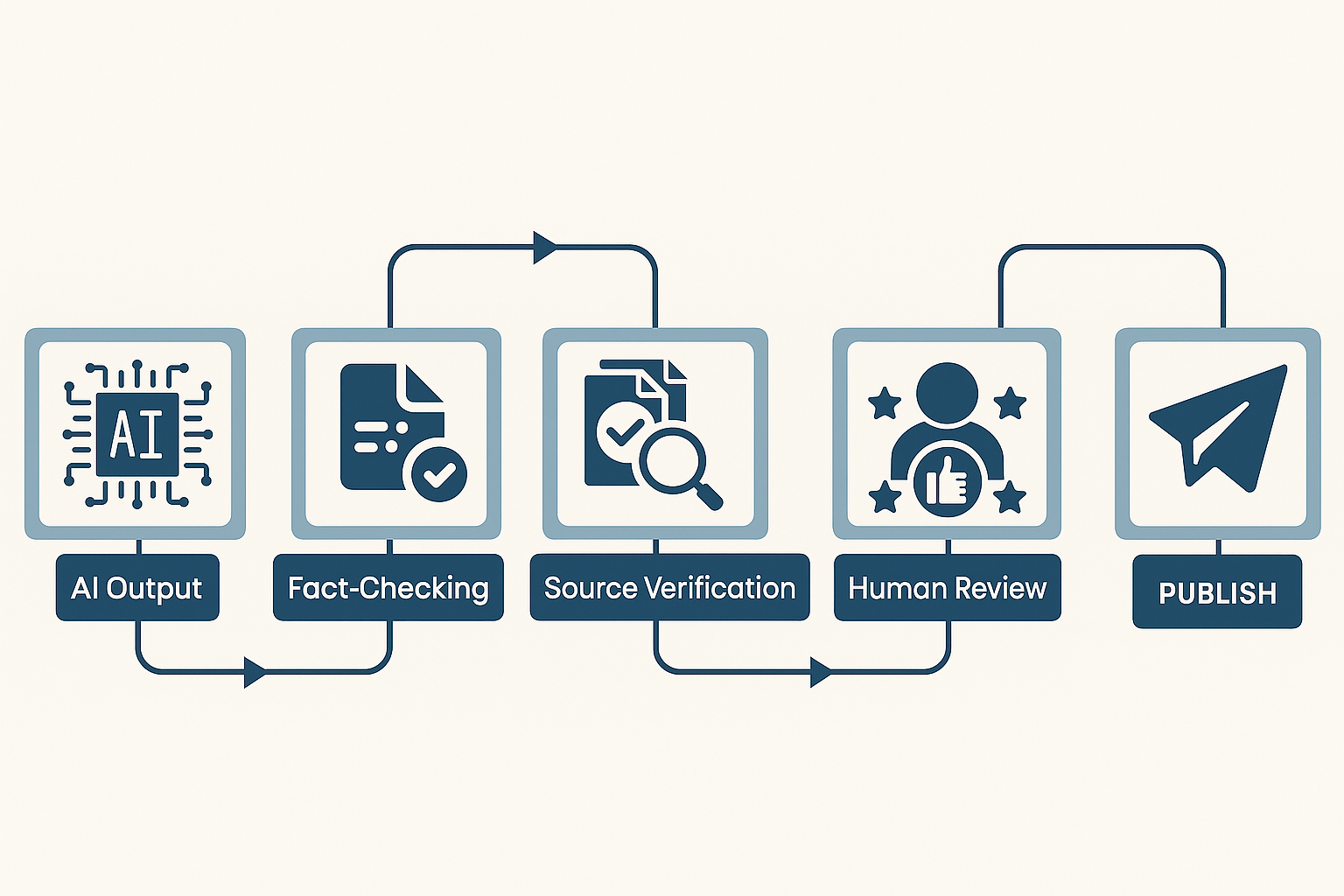
- “Diagram showing four steps for fact-checking AI-generated content”*
Structured workflows reduce risks, improve consistency, and help teams meet deadlines without sacrificing content integrity. For teams handling large volumes of AI-generated content, integrating these workflows with tools like ContentLift can streamline the entire verification process.
4. Monitor and Adapt Over Time
Keep track of errors, patterns in AI hallucinations, and common verification problems. Regularly review your results and update your guidelines to stay ahead of new AI content risks. Continuous improvement makes sure your verification methods stay effective as AI content fact checking tools advance and content needs change.
5. Prioritise Critical Content
Not all content requires the same level of scrutiny. Prioritise high-impact materials such as:
- Regulatory communications
- Marketing campaigns with a broad reach
- Blog content targeting competitive keywords
Focusing fact checker tools and human review on critical pieces maximises ROI and protects brand reputation.
Section 6: The Future of AI Content Fact-Checking
As AI-generated content becomes more common, the world of AI content fact checking is changing quickly. By 2026, experts estimate that 90% of online content will be made by AI, so having reliable verification tools is essential for accuracy and brand trust.
1. AI-Assisted Verification Tools on the Horizon
Next-generation fact checker tools will use advanced machine learning to cross-reference claims in real time, spot subtle AI hallucinations, and give useful recommendations. New methods like Retrieval-Augmented Generation (RAG) will let content be checked against several trusted datasets at once, improving AI accuracy. Teams that start using platforms like YAi early can get ahead by adding these AI-assisted verification features to their workflows.
2. Integration with Compliance and Regulations
New regulations will require more transparency, source verification, and content accountability. Businesses will need to use structured content validation processes to show they meet industry and government standards. Platforms with automated tracking, reporting, and audit trails will be essential for teams handling lots of AI-generated content.
3. Maintaining Trust in a Generative AI Era
As AI tools create more advanced content, trust will depend on clear verification methods. Companies should explain how AI content fact checking is performed, what sources they use, and how they fix errors. Teams that focus on transparency and consistency will build credibility with their audiences and avoid reputational risks.
4. Human-in-the-Loop Remains Critical
Even as automation improves, human oversight will still be necessary. Careful judgment is needed to spot context-based mistakes and review subjective claims that automated systems might miss. Using both fact checker tools and human review together gives the best AI accuracy and reliable content validation.
5. Are Fears About AI Misinformation Overblown? A Look at the Evidence
Public discussions often claim that generative AI is spreading misinformation faster, but recent research gives a more balanced view. A peer-reviewed study in the Misinformation Review found little evidence that AI is significantly increasing public exposure to misinformation. Although AI can produce inaccurate or misleading outputs, the paper suggests that the most extreme fears are not yet supported by data.
This doesn’t reduce the need for strong AI content validation, structured fact checking, or reliable fact checker tools. Instead it highlights why businesses still need clear workflows to limit AI hallucinations, maintain accuracy, and make sure every AI-generated claim is verified.
This evidence brings balance to the debate: researchers challenge exaggerated public fears, while marketers still face real risks like outdated facts, invented citations, and missing context. Effective content validation helps close that gap.
FAQ Section
1. What is AI content fact-checking?
Answer: AI content fact checking is the process of verifying the accuracy, reliability, and sources of AI-generated content. It ensures information is factual, reduces AI hallucinations, and strengthens content validation workflows.
2. Why is AI content verification important in 2026?
Answer: AI content verification is essential because even advanced AI can produce errors. Ensuring AI accuracy protects brand credibility, improves SEO performance, and reduces the risk of sharing misinformation. Tools like ContentLift can help teams automate this process while keeping human oversight.
3. What are the types of AI content fact-checking tools?
Answer: Tools range from lightweight browser checkers to enterprise-grade fact checker tools that combine automated verification with human review. Some focus on detecting AI hallucinations, while others offer full content validation workflows for blogs, social media, and reports.
4. Can I buy AI content verification software online?
Answer: Yes, platforms like ContentLift offer online subscriptions for AI content verification. Teams can trial these tools for free, test features, and scale according to content volume and verification needs.
5. How do AI hallucinations affect content?
Answer: AI hallucinations occur when AI generates content that appears credible but is inaccurate. Identifying and correcting these errors is crucial for maintaining AI accuracy, protecting trust, and producing high-quality AI-generated content.
6. How does content validation software compare to AI fact-checking tools?
Answer: While content optimisation tools improve readability, SEO, and tone, AI fact-checking tools are specifically designed for accuracy verification. Combining both approaches ensures trustworthy, high-performing content.
7. What are the best content validation options for 2026?
Answer: The best solutions integrate AI content fact checking automation with human review. Key features include real-time verification, multi-source cross-referencing, and workflow integration. Platforms like ContentLift exemplify this approach.
8. Are there affordable AI fact-checking tools in London?
Answer: Yes, lightweight browser extensions and SaaS platforms provide cost-effective content validation. Trial plans let teams test verification workflows before committing to subscription services.
Conclusion
AI content fact checking is no longer optional, especially as AI-generated content dominates digital channels. Ensuring accuracy, credibility, and reliability requires combining automation, human review, and robust verification workflows. Platforms like ContentLift allow marketers to trial fact checker tools for free, helping teams streamline content validation while minimising AI hallucinations and errors.
Next steps: Read supporting blogs and case studies for practical tips, use structured verification workflows, and add AI-assisted fact checking to your content strategy. By doing so, teams maintain AI accuracy, protect brand trust, and publish high-quality content at scale.
Author Bio
Jessy Conflon – Co-founder & COO/CMO at YAi
Jessy has over 12 years of experience in marketing technology and AI-driven content evaluation. At YAi, she helps marketers create accurate, reliable, and high-quality AI-generated content. She focuses on putting AI content fact checking into practice, reducing AI hallucinations, and improving content validation workflows.